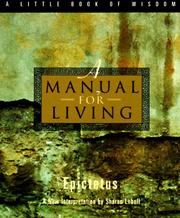
Imported from Open Library. Subjects: Early works to 1800, Conduct of life, Ancient Ethics, Ethik, Ethics
Spoiler-free
Before you read
Imported from Open Library. Subjects: Early works to 1800, Conduct of life, Ancient Ethics, Ethik, Ethics
Full summaryContains spoilers
100 as interpreted by Sharon Lebell Silence appears golden only to the turbulent mind. What do you think concerning the lessons contained herein? First, say to yourself what you would be; then do what you have to do. A Manual for Living Know what you can control and what you can't Happiness and freedom begin with a clear understanding of one principle: Some things are within our control, and some things are not. It is only after you have faced up to this fundamental rule and learned to distinguish between what you can and can't control that inner tranquility and outer effectiveness become possible. Within our control are our own opinions, aspirations, desires, and the things that repel us. These areas are quite rightly our concern, because they are directly subject to our influence. We always have a choice about the contents and character of our inner lives. Outside our control, however, are such things as what kind of body we have, whether we're born into wealth or strike it rich, how we are regarded by others, and our status in society. We must remember that those things are externals and are therefore not our concern. Trying to control or to change what we can't only results in torment. Remember: The things within our power are naturally at our disposal, free from any restraint or hindrance; but those things outside our power are weak, dependent, or determined by the whims and actions of others. Remember, too, that if you think that you have free rein over things that are naturally beyond your control, or if you attempt to adopt the affairs of others as your won, your pursuits will be thwarted and you will become a frustrated, anxious, and fault-finding person. Stick with your own business Keep your attention focused entirely on what is truly your own concern, and be clear that what belongs to others is their business and none of yours. If you do this, you will be impervious to coercion and no one can ever hold you back. You will be truly free and effective, for your efforts will be put to good use and won't be foolishly squandered finding fault with or opposing others. In knowing and attending to what actually concerns you, you cannot be made to do anything against your will; others can't hurt you, you don't incur enemies or suffer harm. If you aim to live by such principles, remember that it won't be easy: you must give up some things entirely; and postpone others for now. You may well have to forego wealth and power if you want to assure the attainment of happiness and freedom. Recognize appearances for what they really are From now on, practice saying to everything that appears unpleasant: "You are just an appearance and by no means what you appear to be." And then thoroughly consider the matter according to the principles just discussed, primarily: Does this appearance concern the things that are within my own control or those that are not? If it concerns anything outside your control, train yourself not to worry about it. Desire demands its own attainment mercurial: (of a person) subject to sudden or unpredictable changes of mood or mind Our desires and aversions are mercurial rulers. Desire commands us to run off and get what we want. Aversion insists that we must avoid the things that repel us. Typically when we don't get what we want, we are disappointed, and when we get what we don't want, we are distressed.
Interpretation
Central ideas
Recurring concerns and concepts identified across the indexed text.
Meaning
Harmonize your actions with the way life is Don't try to make your own rules. In the particulars of your own daily life with its uniquely personal tasks and duties.
View supporting passages
“Harmonize your actions with the way life is Don't try to make your own rules.”
“In the particulars of your own daily life with its uniquely personal tasks and duties.”
“Those are are dedicated to a life of wisdom understand that the impulse to blame something or someone is foolishness, that there is nothing to be gained in blaming, whether it be others or oneself.”
Freedom
A Manual for Living Know what you can control and what you can't Happiness and freedom begin with a clear understanding of one principle: Some things are within our control, and some things are not. We always have a choice about the contents and character of our inner lives.
View supporting passages
“A Manual for Living Know what you can control and what you can't Happiness and freedom begin with a clear understanding of one principle: Some things are within our control, and some things are not.”
“We always have a choice about the contents and character of our inner lives.”
“You may well have to forego wealth and power if you want to assure the attainment of happiness and freedom.”
Family
"Still, it would be great to have money and power and to be able to share them with my friends." If I can get rich and powerful while preserving my own honor, faithfulness to family, friends, principles, and self- respect, show me how and I'll do it. That he is your father implies a fundamental, durable link between the two of you.
View supporting passages
“"Still, it would be great to have money and power and to be able to share them with my friends." If I can get rich and powerful while preserving my own honor, faithfulness to family, friends, principles, and self- respect, show me how and I'll do it.”
“That he is your father implies a fundamental, durable link between the two of you.”
“You are naturally obligated to care for him, to listen to his advice, to exercise patience in hearing his views, and to respect his guidance. fatuous: silly and pointless filial: of or due from a son or daughter However, let us suppose that he's not a good father.”
Faith and doubt
Disregard what doesn't concern you Spiritual progress requires us to highlight what is essential and to disregard everything else as trivial pursuits unworthy of our attention. To do so is to be bewildered by appearances and will only make you doubt yourself.
View supporting passages
“Disregard what doesn't concern you Spiritual progress requires us to highlight what is essential and to disregard everything else as trivial pursuits unworthy of our attention.”
“To do so is to be bewildered by appearances and will only make you doubt yourself.”
“Spiritual progress is made through confronting death and calamity Instead of averting your eyes from the painful events of life, look at them squarely and contemplate them often.”
Responsibility
Focus on your main duty There is a time and place for diversion and amusements, but you should never allow them to override your true purposes. Don't be bothered by such concerns as "People don't think well of me," and "I'm nobody." Even if you reputation were really to matter, you're not responsible for what others think of you.
View supporting passages
“Focus on your main duty There is a time and place for diversion and amusements, but you should never allow them to override your true purposes.”
“Don't be bothered by such concerns as "People don't think well of me," and "I'm nobody." Even if you reputation were really to matter, you're not responsible for what others think of you.”
“But if your desire to contribute to society compromises your moral responsibility how can you serve your fellow cities when you've become irresponsible and shameless?”
Love and compassion
It is a fact of life that other people, even people who love you, will not necessarily agree with your ideas, understand you, or share your enthusiasms. What is hurting this person is the response he or she has uncritically adopted." It is not a demonstration of kindness or friendship to the people we care about to join them in indulging in wrongheaded, negative feelings.
View supporting passages
“It is a fact of life that other people, even people who love you, will not necessarily agree with your ideas, understand you, or share your enthusiasms.”
“What is hurting this person is the response he or she has uncritically adopted." It is not a demonstration of kindness or friendship to the people we care about to join them in indulging in wrongheaded, negative feelings.”
“Still, if you find yourself in a conversation with someone who is depressed, hurt, or frustrated, show them kindness and give them a sympathetic ear; just don't allow yourself to be pulled down too.”
Suffering
Open your eyes: See things for what they really are, thereby sparing yourself the pain of false attachments and avoidable devastation. Don't dread death or pain; dread the fear of death or pain.
View supporting passages
“Open your eyes: See things for what they really are, thereby sparing yourself the pain of false attachments and avoidable devastation.”
“Don't dread death or pain; dread the fear of death or pain.”
“Therefore, when we suffer setbacks, disturbances, or grief, let us never place the blame on others, but on our own attitudes. reproach: address (someone) in such a way as to express disapproval or disappointment Small-minded people habitually reproach others for their own misfortunes.”
Justice
They are mortal, just as you are, and the law of mortality is completely out of your hands. The divine will exists and directs the universe with justice and goodness.
View supporting passages
“They are mortal, just as you are, and the law of mortality is completely out of your hands.”
“The divine will exists and directs the universe with justice and goodness.”
“Fix your resolve on expecting justice and goodness and order, and they will increasingly reveal themselves to you in all your affairs.”
Close reading
Important passages
“A Manual for Living Know what you can control and what you can't Happiness and freedom begin with a clear understanding of one principle: Some things are within our control, and some things are not.”
This passage relates to Freedom.
FreedomChunk 0
“You may well have to forego wealth and power if you want to assure the attainment of happiness and freedom.”
This passage relates to Freedom.
FreedomChunk 1
“Open your eyes: See things for what they really are, thereby sparing yourself the pain of false attachments and avoidable devastation.”
This passage relates to Suffering.
SufferingChunk 1
“Therefore, when we suffer setbacks, disturbances, or grief, let us never place the blame on others, but on our own attitudes. reproach: address (someone) in such a way as to express disapproval or disappointment Small-minded people habitually reproach others for their own misfortunes.”
This passage relates to Suffering.
SufferingChunk 3
“Those are are dedicated to a life of wisdom understand that the impulse to blame something or someone is foolishness, that there is nothing to be gained in blaming, whether it be others or oneself.”
This passage relates to Meaning.
MeaningChunk 3
“It is a fact of life that other people, even people who love you, will not necessarily agree with your ideas, understand you, or share your enthusiasms.”
This passage relates to Love and compassion, Meaning.
Love and compassionMeaningChunk 3
“Focus on your main duty There is a time and place for diversion and amusements, but you should never allow them to override your true purposes.”
This passage relates to Responsibility.
ResponsibilityChunk 4
“Make full use of what happens to you Every difficulty in life presents us with an opportunity to turn inward and to invoke our own submerged inner resources.”
This passage relates to Meaning.
MeaningChunk 4
“If you encounter an attractive person, then self-restraint is the resource needed; if pain or weakness, then stamina; if verbal abuse, then patience.”
This passage relates to Suffering.
SufferingChunk 4
“As time goes by and you build on the habit of matching the appropriate inner resource to each incident, you will not tend to get carried away by life's appearances.”
This passage relates to Meaning.
MeaningChunk 5
“The important thing is to take great care with what you have while the world lest you have it, just as a traveler takes care of a room at an inn. emphasis added The good life is the life of inner serenity The surest sign of the higher life is serenity.”
This passage relates to Meaning.
MeaningChunk 5
“If you seek the higher life, refrain from such common patterns of thinking as these: "If I don't work harder, I'll never earn a decent living, no one will recognize me, I'll be a nobody," or "If I don't criticize my employee, he'll take advantage of my good will." It's much better to die of hunger unhindered by grief and fear than to live affluently beset with worry, dread, suspicion, and unchecked desire.”
This passage relates to Suffering, Meaning.
SufferingMeaningChunk 5
Literary reading
Literary analysis
We always have a choice about the contents and character of our inner lives. But remember that they have their own distinct character, which is quite a separate matter from how we happen to regard them. emphasis added As an exercise, consider the smallest things to which you are attached. Character matters more than reputation perquisties: another term forperks; things regarded as a special rights or privileges enjoyed as a result of one's position Worry and dread are a waste of time and do not set a good example for others.
Literary observation 1
We always have a choice about the contents and character of our inner lives.
Literary observation 2
But remember that they have their own distinct character, which is quite a separate matter from how we happen to regard them. emphasis added As an exercise, consider the smallest things to which you are attached.
Literary observation 3
Character matters more than reputation perquisties: another term forperks; things regarded as a special rights or privileges enjoyed as a result of one's position Worry and dread are a waste of time and do not set a good example for others.
Literary observation 4
What real difference does it make to your character and well-being if you have a powerful position or get invited to fancy parties?
Literary observation 5
It's better if you help me become a good person than to push me to do things that threaten my good character.
Literary observation 6
When it comes to your fundamental duty as a son or daughter, whatever your father's character may be, whatever his personality or habits are, is secondary.
Ideas
Philosophical analysis
A Manual for Living Know what you can control and what you can't Happiness and freedom begin with a clear understanding of one principle: Some things are within our control, and some things are not. You may well have to forego wealth and power if you want to assure the attainment of happiness and freedom. One of the signs of the dawning of moral progress is the gradual extinguishing of blame.
Philosophical observation 1
A Manual for Living Know what you can control and what you can't Happiness and freedom begin with a clear understanding of one principle: Some things are within our control, and some things are not.
Philosophical observation 2
You may well have to forego wealth and power if you want to assure the attainment of happiness and freedom.
Philosophical observation 3
One of the signs of the dawning of moral progress is the gradual extinguishing of blame.
Philosophical observation 4
Moral progress results in freeom from inner turmoil.
Philosophical observation 5
Say to yourself, "Coping calmly with this inconvenience is the price I pay for my inner serenity, for freedom from perturbation; you don't get something for nothing." When you call your child, be prepared that she may not respond to you, or if she does, she might not do what you want her to do.
Philosophical observation 6
Keeping your will in harmony with truth and concerning yourself with what is beyond your control are mutually exclusive.
Context
Historical context
Outside our control, however, are such things as what kind of body we have, whether we're born into wealth or strike it rich, how we are regarded by others, and our status in society. Don't make the mistake of assuming that celebrities, public figures, political leaders, the wealthy, or people with great intellectual or artistic gifts are necessarily happy. "But what about my position in society?" you ask.
Historical observation 1
Outside our control, however, are such things as what kind of body we have, whether we're born into wealth or strike it rich, how we are regarded by others, and our status in society.
Historical observation 2
Don't make the mistake of assuming that celebrities, public figures, political leaders, the wealthy, or people with great intellectual or artistic gifts are necessarily happy.
Historical observation 3
"But what about my position in society?" you ask.
Historical observation 4
But if your desire to contribute to society compromises your moral responsibility how can you serve your fellow cities when you've become irresponsible and shameless?
Historical observation 5
If you try to be something you're not or strive for something completely beyond your present capacities, you end up as a pathetic dabbler, trying first to be a wise person, then a bureaucrat, then a politician, then a civic leader.
Historical observation 6
Nobody cares that much about your war stores and dramatic adventures, though they might indulge you for a while to appear polite.
Reflection
Questions to carry
philosophical
What does genuine freedom require, and what responsibilities accompany it?
Consider whether freedom is presented as liberation, burden, temptation or moral obligation.
theological
How does the work distinguish faith from certainty?
Examine how belief is tested by suffering, doubt, reason and human relationships.
ethical
To what extent are people responsible for consequences they desired but did not directly cause?
Consider the relationship between thought, intention, action, guilt and shared responsibility.
ethical
Does suffering transform the characters, or merely expose who they already are?
Compare the different ways characters respond to pain, loss and injustice.
philosophical
Is legal judgment presented as equivalent to moral judgment?
Notice where institutional justice agrees or conflicts with conscience and truth.
Your reading
Personal synthesis
Add notes or annotate saved quotations, then refresh Book Intelligence to generate a reflection on what you are noticing in this book.
71 source chunks185,756 characters analyseddeterministic-book-v2-personalGenerated 2 Aug 2026, 00:10
![Man's Search for Meaning adapted for Young Adults [adaptation] cover](https://covers.openlibrary.org/b/id/11203708-L.jpg)