Author Room
Franz Kafka
Writer of alienation, authority, uncertainty and impossible transformations.
“A book must be the axe for the frozen sea within us.”
3
Books
0
Quotes
0
Notes
0
Ideas
Collected works
Books in your library
Works by Franz Kafka currently preserved in Codex.

Amerika
Franz Kafka
"Franz Kafka's diaries and letters suggest that his fascination with America grew out of a desire to break away from his native Prague, even if only in his imagination. Kafka died before he could finish what he liked to call his ''American novel," but he clearly entitled it Der Verschollene ("The Missing Person") in a letter to his fiancee, Felice Bauer, in 1912. Kafka began writing the novel that fall and wrote the last completed chapter in 1914, but it wasn't until 1927, three years after his death, that Amerika - the title that Kafka's friend and literary executor Max Brod gave his edited version of the unfinished manuscript - was published in Germany by Kurt Wolff Verlag. An English translation by Willa and Edwin Muir was published in Great Britain in 1932 and in the United States in 1946." "Over the last thirty years, an international team of Kafka scholars has been working on German-language critical editions of all of Kafka's writings, going back to the original manuscripts and notes, correcting transcription errors, and removing Brod's editorial and stylistic interventions to create texts that are as close as possible to the way the author left them." "With the same expert balance of precision and nuance that marked his award-winning translation of The Castle, Mark Harman now restores the humor and particularity of language in his translation of the critical edition of Der Verschollene. Here is the story of young Karl Rossmann, who, following an incident involving a housemaid, is banished by his parents to America. With unquenchable optimism and in the company of two comic-sinister companions, he throws himself into misadventure after misadventure, eventually heading toward Oklahoma, where a career in the theater beckons. Though we can never know how Kafka planned to end the novel, Harman's superb translation allows us to appreciate, as closely as possible, what Kafka did commit to the page."--Jacket.
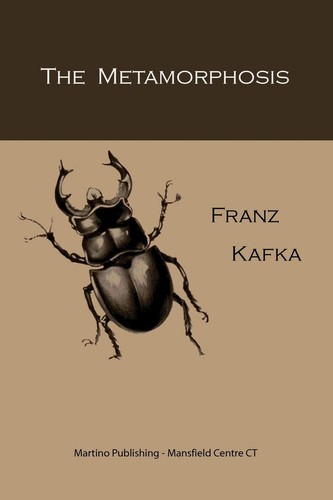
Metamorphosis
Franz Kafka
Metamorphosis (German: Die Verwandlung) is a novella written by Franz Kafka which was first published in 1915. One of Kafka's best-known works, Metamorphosis tells the story of salesman Gregor Samsa, who wakes one morning to find himself inexplicably transformed into a huge insect (German: ungeheueres Ungeziefer, lit. "monstrous vermin") and subsequently struggles to adjust to this new condition. The novella has been widely discussed among literary critics, with differing interpretations being offered. In popular culture and adaptations of the novella, the insect is commonly depicted as a cockroach. With a length of about 70 printed pages over three chapters, it is the longest of the stories Kafka considered complete and published during his lifetime. The text was first published in 1915 in the October issue of the journal Die weißen Blätter under the editorship of René Schickele. The first edition in book form appeared in December 1915 in the series Der jüngste Tag, edited by Kurt Wolff.

Short stories
Franz Kafka
This collection of new translations brings together the small proportion of Kafka's works that he thought worthy of publication. It includes 'Metamorphosis', his most famous work, an exploration of horrific transformation and alienation; 'Meditation', a collection of his earlier studies; 'The Judgement', written in a single night of frenzied creativity; 'The Stoker', the first chapter of a novel set in America and a fascinating occasional piece, 'The Aeroplanes at Brescia', Kafka's eyewitness account of an air display in 1909. Together, these stories reveal the breadth of Kafka's literary vision and the extraordinary imaginative depth of his thought.
Constellation
Ideas connected to this thinker
Concepts through which this author appears across your books, notes, quotations and conversations.
No connected ideas yet.
Marginalia
Your notes
Thoughts and reflections you have attached directly to Franz Kafka.
You have not written any author-level notes yet.
Voices
Saved quotations
Passages from works by Franz Kafka that you chose to preserve.
No saved quotations were found.